Hiring a Meta Ads Agency in the US in 2026: What Actually Changed

Key Takeaways
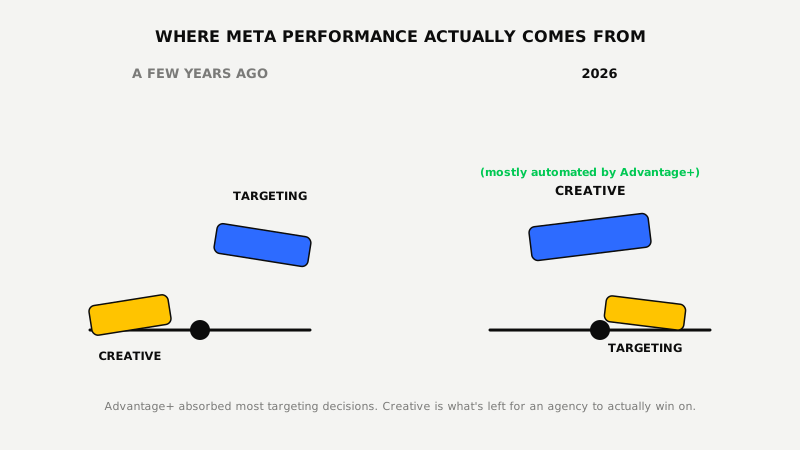
- Creative decides more of your Meta performance than targeting does. An agency that outsources or ignores creative is optimizing the smaller lever.
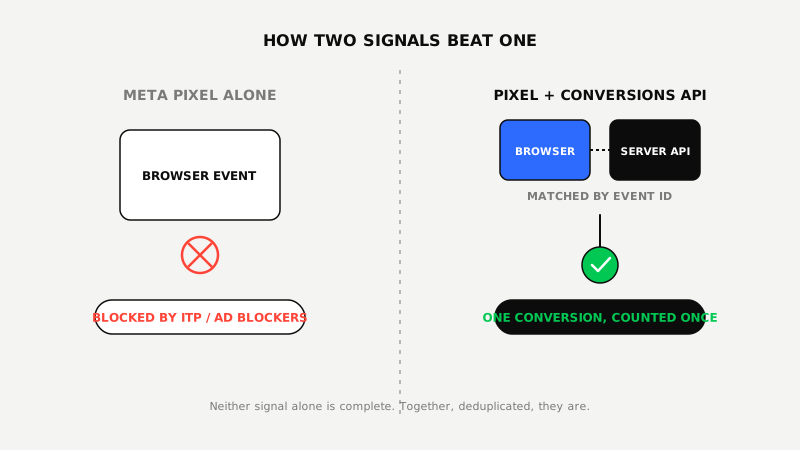
- Meta's Conversions API is no longer optional. Browser-only pixel tracking misses conversions that ad blockers and Safari's privacy settings quietly erase.
- A guaranteed ROAS with no conditions attached is a sales tactic, not a forecast. Nobody controls your offer or your competitors' spend.
- Meta needs 7+ days to learn from a new campaign. Judge an agency on the system they build, not the first week of numbers.
What Actually Changed in 2026
Facebook advertising has become a creative problem before it's a targeting problem. Meta's algorithm rewards engagement, and engagement comes almost entirely from creative quality now that Advantage+ has taken over most of the audience and placement decisions a media buyer used to control by hand. Vertical video, format diversity, and a real testing pipeline outperform tight audience segmentation every time.
The second shift is quieter but just as costly: tracking keeps degrading. Every account still running on browser pixel data alone is working from an incomplete picture, missing conversions that ad blockers and iOS privacy settings never let through.
Your account's performance is just a creative decay curve in slow motion if there's nothing new behind it.
Creative Is The Lever Most Agencies Still Ignore
Ask a Meta ads agency who actually builds their creative. A lot of "full-service" agencies manage the campaign shell and outsource or skip the part that decides whether it works. If nobody on the account can explain why one ad wins and another fatigues in two weeks, they're managing spend, not performance.
The Questions Most Agencies Can't Answer
- "How do you handle conversions when the browser pixel misses one?" The real answer involves the Conversions API firing independently of the browser, deduplicated against the pixel by a shared event ID. If they can't describe this in plain terms, they're optimizing on partial data.
- "What's your creative testing cadence?" If the answer is "we launch and monitor," that's not a system, that's waiting.
- "What happens to performance in the first week?" Meta needs real time to learn from a new or restructured campaign. An agency promising instant stability either hasn't rebuilt anything real or is about to disappoint you.
We rebuilt our own conversion tracking around exactly this: browser pixel plus an independent server-side Conversions API call, tied together with a shared event ID, so an ad blocker or Safari's privacy settings can't quietly erase a real conversion. It's the current baseline, not a differentiator, but most agencies still can't describe it when asked directly.
Red Flags Worth Walking Away From
- A guaranteed ROAS with no conditions attached. Nobody controls your offer, your market, or what your competitors spend this month.
- Creative handed off to a white-label or offshore vendor with no visibility. Ask directly who builds and manages the account day to day.
- Reports full of reach, CTR, and platform-claimed leads with no line back to real revenue. Platform metrics are not business outcomes.
- Judging a new account inside the first week. Meta's system needs time to learn. An agency panicking or promising instant fixes in week one doesn't understand the platform they're selling.
Why We Built Proof Before Partnership™
You can't evaluate a Meta ads agency from a sales deck, you evaluate the creative system and the tracking they actually build. That's why the Meta Growth Proof Program™ rebuilds your account and proves the creative system works in your first month for $800, not a long-term contract signed on a promise. We've used this exact approach to take real Meta accounts from a $170 cost per lead to $90, while lead volume climbed from 36 to 137 in the same window, and we'd rather prove that to you than tell you about it.
See what a real creative system and tracking setup looks like before you commit.
See The $1,000 Meta Growth Proof Program™ ↗